The Department of Chicana and Chicano Studies offers a competitive honors program that allows motivated undergraduates to work with either a Chicana/o Studies faculty member or an affiliated faculty member to produce an advanced academic project during their junior or senior year. Upon successful completion of all requirements, students will graduate with “Distinction in the Major".
To be eligible for the Honors Program, students must:
- Be a Chicana and Chicano Studies major.
- Have a minimum cumulative GPA of 3.0.
- Have a minimum 3.5 GPA in the major.
- Students who fall slightly below the major GPA requirement may be considered under special circumstances.
Before submitting an application, students must identify and secure a faculty mentor who agrees to supervise their honors research project throughout the academic year. Students are expected to meet with a prospective mentor to discuss their research interests and obtain the faculty member's commitment to serve as their mentor before applying to the program. Faculty mentors provide guidance and support throughout every stage of the honors project. Students may work with either a Chicana/o Studies faculty member or an affiliated faculty member. A list of department and affiliated faculty is available here:
https://www.chicst.ucsb.edu/people
A complete application consists of:
- A completed Honors Program application.
- A one-page cover letter that addresses:
- Why you are interested in participating in the Honors Program.
- Your proposed research topic or topics.
- Any previous research experience (if applicable).
- One letter of recommendation from a Chicana/o Studies or affiliated faculty member who is familiar with your academic work. This recommender does not need to be your proposed faculty mentor.
- Confirmation from your proposed faculty mentor indicating their willingness to supervise your honors project (email confirmation is acceptable).
Students admitted to the Honors Program complete a three-quarter sequence of 4-unit courses over the course of one academic year. Each course builds on the previous one, guiding students from the development of a research proposal to the completion of an honors thesis.
Fall Quarter - CH ST 197HA – Honors Project Seminar (4 units)
Students develop their honors research project by refining their research question, conducting background research, establishing an appropriate research design and methodology, and creating a plan for their project.
Winter Quarter - CH ST 197HB – Honors Project Research (4 units)
Students conduct the primary research for their honors project. During this quarter, they gather, organize, and analyze data while continuing to meet regularly with their faculty mentor for guidance and feedback.
Spring Quarter - CH ST 197HC – Honors Project Writing (4 units)
Students complete the writing of their honors research and prepare a formal presentation of their research to share with faculty members and peers.
Each honors course is worth 4 units and meets once per week for approximately two hours. In addition to attending the weekly seminar, students are expected to meet regularly with their faculty mentor throughout the academic year to discuss their progress, receive feedback, and stay on track toward completing their honors research project.
2026-2027 Application
PLEASE NOTE: The Fall Honors Seminar (CH ST 197HA) meets on Wednesdays from 9:00–10:50 a.m.
2025-2026 Academic Year Projects
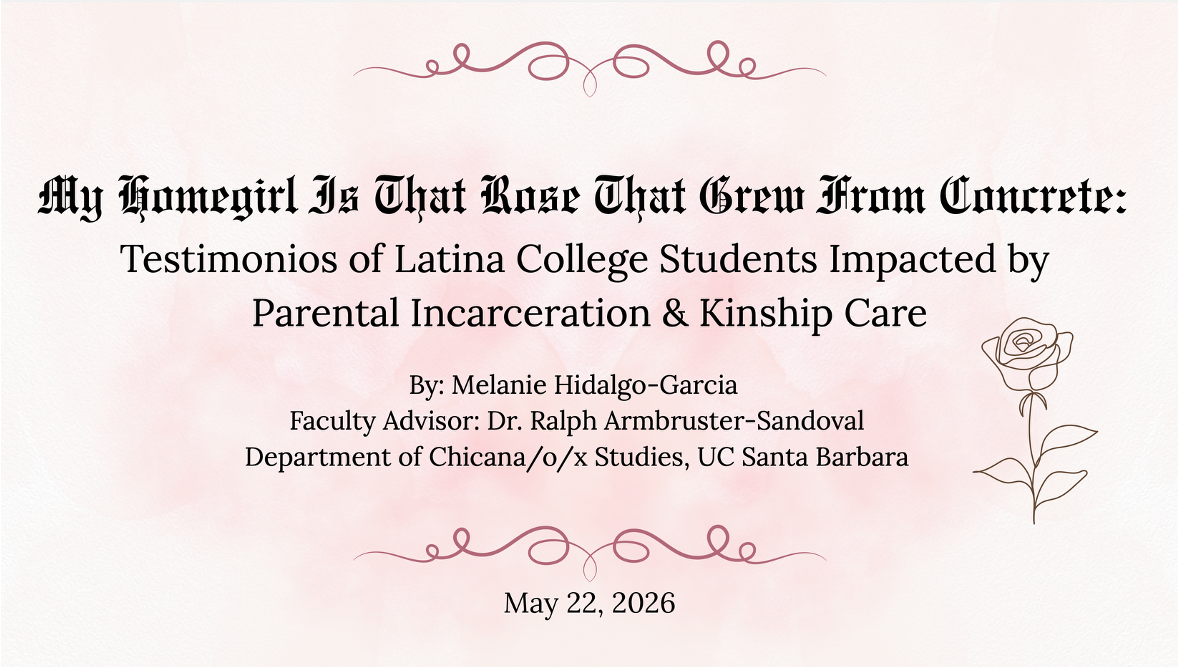
Melanie Hidalgo-Garcia
Many system-impacted Latina students did not know about support programs until later in their college journey. Because of this, they spent many years believing they had to deal with trauma, stress, and school challenges alone.
- Crenshaw's (2013) work on intersectionality reminds us that women of color experience overlapping pressures (gender, race, class, and family trauma), yet schools rarely offer programs that address these combined needs.
- Because these resources aren't known or explained to students, they grow up believing their struggles are their fault instead of seeing them as symptoms of unequal school systems.
- Many system-impacted Latina students only begin healing once they enter college and discover communities designed for them

Jay Landaverde
Research Significance
Highlighting the success of children of immigrant parents. Despite the impact of the U.S. immigration system, all participants are pursuing higher education and creating a sense of privilege within their own lives.
Emerging Implications
Creating safe spaces for young scholars and building a barrier of resilience during pivotal stages of personal growth and decision-making.
Broader Implications for Latinx Youth
Systemic involvement and forced separation often lead to identity insecurities (lowered self-confidence, lost autonomy).
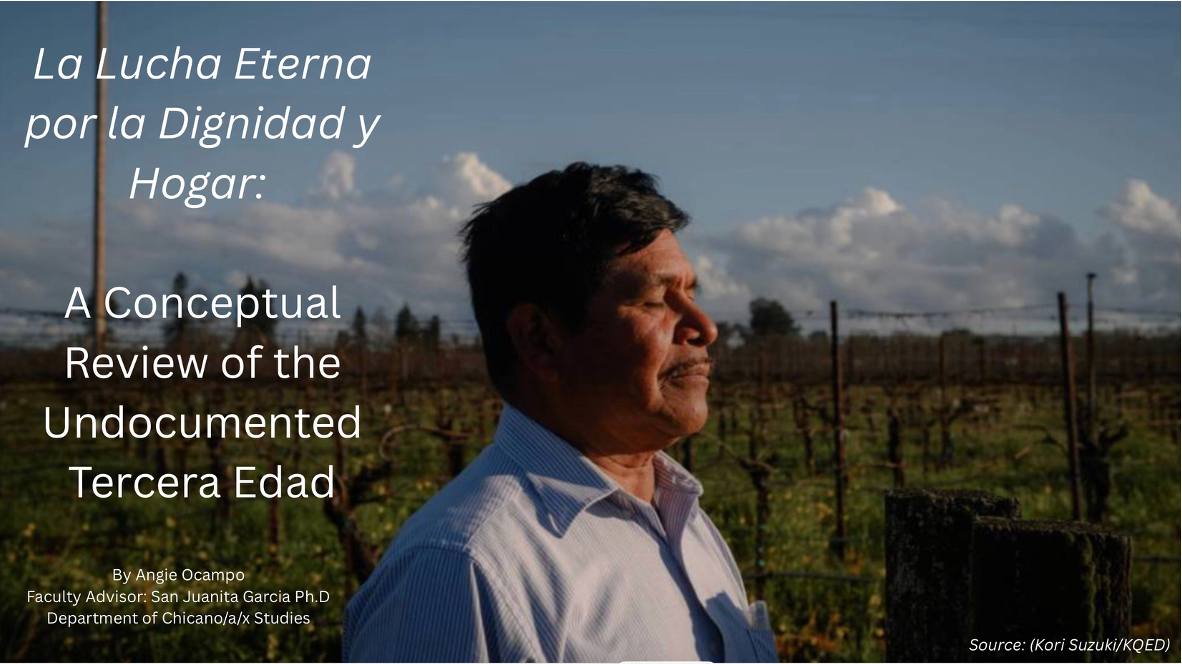
Angie Ocampo
Educational and social impacts of legal status on undocumented immigrants from Latin America has been significantly studied.
Missing from this work = intersections between aging and undocumented status
My research calls attention to undocumented aging individuals who are headed towards and are living the "tercera edad".
Defining the "tercera edad" = sector of the population usually around the age of 65 and older who are societally prescribed as being entitled to retire from the workforce.
"Tercera edad" also characterized by biological, psychological, and social changes.
Special thanks
to our Honors Advisors!
Professor Ralph Armbruster-Sandoval
Professor San Juanita Garcia
We are deeply grateful for their invaluable guidance and mentorship to our Chicanx/a/o Studies Honors students. Their expertise and continued support has empowered students to challenge narratives and make meaningful contributions to our campus community.
2024-2025 Academic Year Projects
Sasha Alvarez
How do the working conditions and structural inequalities within the H-2A visa program reflect historical patterns of exploitation seen in the Bracero Program, and what potential exists for these conditions to spark a sustained farmworker movement, in the United States?
From milpa fields in El Salvador to the strawberry fields in Oxnard – this is personal.
Grisel Jiménez-Santos
In what ways do the experiences of undocumented University of California students engaged in the Opportunity for All campaign provide insights into shaping dignified immigration reform? How did Opportunity for All fail to address the holistic needs of undocumented people?
Constitutional Citizenship & Immigration federalism
The basis of “legal” citizenship as a social contract with the Nation-State
- the right to civil disobedience
10th Amendment, Article 1-Section 8
- immigration federalism
- Opportunity for All (O4A)

Krystal Gonzalez
How have Ethnic Studies courses affected the academic and personal development of Students of Color at UCSB?
Although Ethnic Studies departments have been expanded at the college level over the course of the last few decades, there has been a resurgence of anti-ethnic studies movements that has been amplified with the new presidential administration
This research is significant because it included the expeirences of students who have taken Ethnic Studies courses in fields including but also outside of Chicana/o Studies here at UCSB.
Rather than strictly focusing on the statistical data of students academic achievement, this research examined if and how their emotions developed as a result of the courses they took that is just as important during such developmental years in our lives as Undergraduate students.
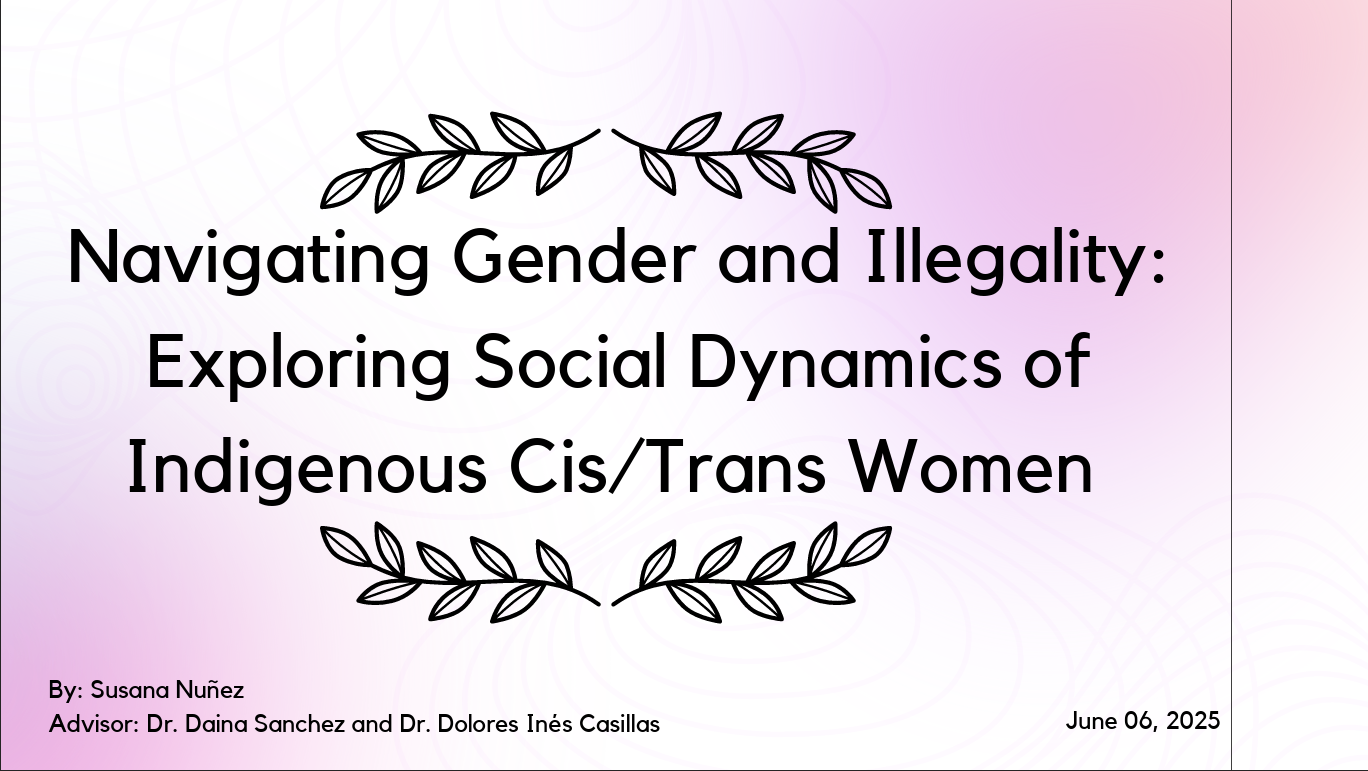
Susana Nuñez
How does race, class, and gender affect the everyday experiences of undocumented, foreign-born, or formerly undocumented Indigenous cis women/trans-women?*
How do race, class, and gender impact undocumented, foreign-born, or formerly undocumented Indigenous cis women/trans-women’s interactions with legal systems, including immigration officials and legal officials?
How do undocumented, foreign-born, or formerly undocumented Indigenous cis women/trans-women’s interactions with mainstream society and legal systems affect their well-being and the wellbeing of their loved ones?*